Subscriptions

Vesuvius DV post cleaned up


Yes, this is the Pompeii killer and those are suburban lights on its flanks.

Not all of them are legal, but there they are.

What if the volcano erupts?

Well, since the Vesuvius cone is geologically young and active (although quiet since 1944), it’s probably a matter of “when” and “how big,” not “if.”

Every volcanologist in the world wants to make sure that Vesuvius doesn’t earn the sad title of “Naples killer” with its next big eruption.

But it’s not easy, turning that wish into reality.

What is Mount Vesuvius?

Technically, it is the “Big Cone” (Gran Cono) of another, larger volcano.

If you check out this tourist’s video across Naples Bay (from the Sorrento Peninsula, perhaps), you’ll see how Vesuvius seems to be sitting inside something else.

That larger structure is Somma Volcano, the granddaddy of Mount Vesuvius.

Its relationship to the “Big Cone” is not uncommon — in fact, we’re going to see “sommas” at several Decade Volcanoes.

This one is the original, and here briefly is its story.

Mount Somma goes back to Pleistocene times and used to be a big shield volcano until, for unknown reasons, things started getting cataclysmic some twenty thousand years ago when Vesuvius arrived on the scene.

A series of huge explosions ripped through the old edifice long ago, and today only Somma’s northern flank – the saddle bump on the left in that image up above – still stands tall above the Campania Plain.

The trouble-making cone that most of us call Vesuvius is the bump on the right.

When the experts are talking formally, everyone from rockhounds to the researchers at Italy’s National Institute of Geophysics and Volcanology (INGV) refers to this dangerous geologic structure on the edge of Naples as the Somma-Vesuvius volcanic complex (SVVC).

When will Vesuvius erupt?

That’s a good question, one that’s hard to answer.

In order to predict the volcano’s next move, scientists are trying to learn everything they can about it.

The history they’ve uncovered so far is not encouraging. Basically, modern Naples has grown up around a violent, moody stone giant that predates the Roman Empire.

Somma is huge, but it doesn’t actually do anything nowadays except host that Gran Cono, a/k/a Mount Vesuvius.

Vesuvius itself is terrible.

Here is a mean-looking overhead view of the SVVC from Linde et al., who also provide its origin story below (I’ve added some [translation] of the scientific terms into plain English):

The history of the SVVC began 0.3–0.5 million years ago [300,000 to 500,000 years ago] and is characterized by periods of closed conduit rest [no eruptions] lasting up to 1000 years that are interrupted by plinian and subplinian explosive eruptions…In the last 22 ka [thousand years], four plinian caldera-forming eruptions (22 ka Pomici di Base, 9.7 ka Mercato, 4.3 ka Avellino, and AD 79 Pompeii) and at least three major subplinian eruptions occurred (17.6 ka Pomici Verdoline, AD 472 Pollena, and AD 1631)…[and Somma’s] summit collapse[d.] [T]hat modified the dimensions and shape of the Mt. Somma caldera…[per INGV and the Global Volcanism Program (GVP), the Gran Cono took on its present shape during a particularly intense VEI 4 eruption in 1906]…Since the AD 1631 subplinian eruption, preceded by about 500 years of rest…Vesuvius entered in an open conduit phase that lasted until March 1944 when, after a violent Strombolian eruption, the volcano entered in a new closed conduit quiescence.

As you might guess, the tricky part now is deciding whether these past eight decades of silence mean that Somma-Vesuvius has settled into another centuries-long nap (sweet, if true!) or that it’s building up for another huge eruption.

In between these two activity extremes of “off” and “cataclysm”, when its conduit is open, Vesuvius can also exude damaging lava flows and has even lit up the Bay of Naples occasionally with impressive lava fountains.(MTU; Scandone et al., 2006)

Such eruptions are too often damaging and deadly, but they do fall within the range of what we think of as “normal” volcanism.

After this goes on for a while, say, from 1631 to 1944, people start thinking of the fire mountain as a scary but lovable (and lucrative) mascot. (Scarth)

They forget that Vesuvius is also capable of real wrath-of-God stuff.

And then it happens (the last time was Pompeii).

This volcano’s moody behavior reflects the geological complexity of its setting.

Somma-Vesuvius sits in a zone where plate tectonics is slowly, inexorably driving the African continent into Eurasia, closing the Mediterranean Sea along the way.

Don’t cancel those vacation plans — this beautiful sea will be with us for many more millennia, but its ultimate doom is to become a layer of sedimentary rocks in unnamed Himalayan-style mountains that will tower over lowlands on the next supercontinent.

In our own time, subduction and other processes related to this ongoing continental collision between Africa and Eurasia keep all of Campania’s volcanoes – notably, Campi Flegrei and Ischia, as well as Vesuvius – alive and kicking. (Carlino; De Natale et al.; Milia et al.; Turco et al.)

Unfortunately, studies of all that geology have not yet led to a consensus on why Vesuvius alternates long stretches of low-level activity (for example, between 1631 and 1944) with either lengthy quiet periods — dreaming for some 800 years, for instance, before the Pompeii eruption. (De Vivo et al.) or with a very violent blast. (Scandone et al., 2006)

Scientists really need to know that and other details of how Vesuvius works in order to help civil authorities protect the volcano’s human neighbors.

One popular hypothesis is that Vesuvius has eruption cycles, spanning hundreds of years, and that these always start with a plinian blast. (MTU; De Vivo et al.)

Cool! Well, not the plinian part, but cycles can be predicted, if they’re well understood.

However, we can’t expect to see an official Vesuvius eruption forecast on the nightly news any time soon.

It is possible to interpret Vesuvian activity patterns in other ways. That is why some volcanologists don’t recognize eruption cycles here. (Scandone et al., 2006)

Bottom line: No one really can say when Somma-Vesuvius will erupt again, but we should know weeks to months ahead of time when one is coming.

With millions of lives at stake in this major international port city, Mount Vesuvius is one of the most heavily monitored volcanoes in the world.

The Decade Volcano program’s main achievement here was the development of a Naples emergency plan in 1995 to cope with the next eruption at Vesuvius, whenever it occurs. (Newhall, 1996, 1999)

The current Plan Vesuvio (2014-2019) is based on an assumption that monitoring data will give 72 hours’ warning of an impending 1631-style subplinian eruption.

The plan has many critics.

Some disagree with the timing, saying eruptions can’t be so precisely predicted.

Others are concerned that the selected worst-case scenario is an event smaller than the Pompeii plinian eruption or the earlier and even larger Avellino blast.

Which brings up the question…How big?

Since we will be looking at the Pompeii eruption in the next section, here are:

The account by Pliny the Younger – who was seventeen years old when the volcano went off and who lost his uncle, Pliny the Elder, in that eruption – is where the term “plinian” comes from. (Scandone et al., 2019)

It’s also the first known recorded observation of an eruption, so in a sense, Mount Vesuvius is where modern volcanology began. (Doronzo et al.; Klemetti, 2010; MTU)

If they were to base Plan Vesuvio on the plinian eruption of AD 79 (after 800 years of quiet), emergency managers today would need to clear out all of Naples metro – almost 4 million people – in a matter of hours.

An evacuation on that scale has never been attempted in modern times.

However, in Vesuvius’ subplinian 1631 eruption (following a 500-year sleep), no caldera formed; the plume wasn’t quite as high as in AD 79; and most pyroclastic flows didn’t run out beyond the volcano’s slopes, although a few did reach the sea.

No one at the time expected pyroclastic flows – which are unsurvivable – and more than 4,000 people died in them. (Brown et al.)

Now that this hazard is better understood, Plan Vesuvio evacuates hundreds of thousands of Neapolitans out of the 1631 pyroclastic flow/heavy ashfall zone in 72 hours.

That’s doable, or as Scarth writes, “In theory, the theory should work.”

But is it a wide enough evacuation zone?

The continuing debate over Plan Vesuvio makes more sense if we can get a feel for the dangers that people are likely to encounter here – or at any volcano – during an eruption.

It’s possible to do that at Vesuvius, more so than at other volcanoes, because the AD 79 eruption’s effects are sometimes personalized in plaster casts of victims, while parts of the Roman world that Vesuvius buried have been found surprisingly well preserved.

It’s probably the closest we’ll ever get to the experience of time travel in real life.

The drawback to this Pompeii approach is its focus on just two of the volcanic hazards here: heavy ashfall and pyroclastic flows.

Earthquakes, lava flows, and mudflows (lahars) are also serious threats. But we can explore those at other Decade Volcanoes.

Vesuvius is the place to look at the basic issue of volcano hazard management, which is this: Disaster hit those people unexpectedly – are we better prepared for it now?

Pompeii

Today, Napoli Centrale train station, in downtown Naples, is just eight miles from Vesuvius. Sprawling around that station for almost 700 square miles is the European Union’s fifth most densely populated urban area.

During its most famous eruption, Roman-era Vesuvius took out not only Pompeii but also Herculaneum, Oplontis, and Stabiae – as well as pretty much everything else within seven miles of the crater. (Doronzo et al.)

There was a lot to take out: towns, villas, seaside resorts, a dense infrastructure network, and, of course, the major regional port and vacation spot for wealthy Romans – Pompeii, about seven miles from Vesuvius.

I got that information from the most thorough and up-to-date source I could find – Doronzo et al. – and will continue to use them for this section, supplemented as noted.

Most of us know the basic story here, but there is one new thing to mention: the date.

You might have seen that given as August 24th.

More findings at Pompeii and analysis of Pliny’s description suggest that the eruption actually happened in autumn, not during the summer.

It’s not definitely established yet, but both the Smithsonian’s Global Volcanism Program (GVP) and Doronzo et al. tentatively go with October 24, 79 AD, for the eruption’s start, not August 24th as previously understood.

Let’s use that date, too.

As this Pompeii reconstruction video shows, Somma-Vesuvius probably looked a little different back then, covered with vegetation, including vineyards, and with the cone taller and flattened on top.

Nothing geologically unusual had happened up there for eight centuries.

Visiting Greeks might have witnessed an eruption, but Somma-Vesuvius was green and quiet when first the Etruscans (524 BC) and then the Romans (about 310 BC) moved into Campania felix, the “Fortune-favored country.” (Carlino; Italian Wikipedia)

That irregular mountain summit seven miles away made a nice backdrop for Pompeii after the settlement was built on an old Vesuvian lava flow near what was then the Sarno River’s mouth.

Pompeii became a municipium in 27 BC and soon grew into a port city, exporting wine to Gaul and importing various commodities. (Italian Wikipedia)

Two thousand years ago, this part of Campania was also a trendy getaway for the rich.

They built lavish villas and vacation homes all over the countryside, as well as in Pompeii and in the seaside town of Oplontis, where some of them located their rustic luxury properties right on the slopes of Vesuvius to get a spectacular view of the Bay of Naples.

Of course, earthquakes are common in Campania. A very powerful temblor in 62 AD, centered in nearby Stabiae, heavily damaged Herculaneum and Pompeii.

Afterwards, Rome sent teams to repair Pompeii’s forum (Luke), and this work was still in progress 17 years later — yes, according to a reliable source (that I can’t find again), authorities were investigating corruption charges about the delay — when the first white steamy clouds appeared above Vesuvius early in the afternoon of October 24. (Scandone et al., 2019)

Molten rock and ground water had just met, causing phreatomagmatic blasts that unplugged the volcano’s conduit.

Long before October 24th, a magma chamber below the SVVC had been refreshed by pulses of hot material coming up from the depths, most recently twenty years earlier. (Doronzo et al.)

This pressurized the chamber, as well as melting its contents.

Rock had cracked and about 4 cubic kilometers of buoyant magma had then pushed its way up through the edifice, causing earthquakes that Pliny the Younger and others in the region noted during the weeks leading up to the eruption.

At the same time, magmatic gases that had stayed dissolved while the molten rock was deep in the earth now started coming out of solution, just like CO2 bubbles out of soda when you open the bottle.

This bubbling increased the speed of that rising melt, as well as its pressure on the rock walls.

More gases came out of solution as magma in the conduit got closer to the surface; more speed, more pressure against the conduit’s cap, more gas bubbles – at some point, eruption became inevitable.

By the time phreatomagmatic explosions uncapped Vesuvius, that rising magma was what Oppenheimer calls a rock foam.

It now blasted out of the newly opened vent at more than 200 mph, sucking in surrounding air and heating it up to build a convection column that shot 10 to 19 miles into the sky before spreading out into an ashy umbrella. (Oppenheimer; Scandone et al., 2019)

This awful spectacle continued for the rest of the afternoon and on into the evening, with prevailing winds blowing the plume southeast of the volcano, over Pompeii. (Scandone et al., 2019)

That city would get almost 10 feet of ashfall before this phase of the eruption ended, but just a few hours after it had begun, enough ash was present – about 2 feet of finely powdered rock – to start breaking Pompeii’s roofs with its weight.

There were people inside many of those buildings.

Thus far, archaeologists have found the remains of 394 individuals under the ruins.

Around 8 p.m., chemistry of the erupting material changed. In practical terms, this made the eruption column unstable.

After initially pulsing up to an altitude of around 22 miles, the column of fresher material now had a series of partial collapses.

These in turn generated pyroclastic flows overnight that were much more extensive than those of 1631 would be.

The first flow hit Herculaneum and was probably the one that killed all those people in the boat houses. (Scandone et al., 2019)

It didn’t get to Pompeii.

Neither did the flows that destroyed Oplontis and its surrounding rustic villas. (Scandone et al., 2019)

Around 6:30 on the morning of the 25th, a pyroclastic flow just brushed Pompeii’s northwestern walls.

When the plinian column collapsed completely, about an hour later, it generated a flow that entered Pompeii but didn’t do much damage.

The worst was yet to come.

Up at Vesuvius, the emptied magma chamber began to fall in on itself, forming a caldera – the vast bowl-shaped depression that today’s Gran Cono sits in.

This caldera formation, which took several minutes, terrified Pliny the Younger, his mother, and other refugees trying to flee Cape Miseno, across the bay from Vesuvius, and it generated strong earthquakes, tsunami in the Bay of Naples, a brief new eruption column, and then the killer pyroclastic flow.

That one, big as it was, was almost spent by the time it reached Pompeii after traveling those seven miles from the volcano.

It entered from the northwest and ran out of energy before reaching the city’s southern walls – but not before its heat had instantly killed at least 650 survivors of the eruption’s earlier events. (Mastrolorenzo et al., 2010)

We have met many of these men, women, and children through the medium of plaster casts.

That was the end of their story, but Vesuvius continued to rumble on for a few more days. Pompeii disappeared under another 20 feet or so of pyroclastic deposits and was not seen by human eyes again until the 1700s.

How many died overall?

According to Scandone et al. (2019), probably not the tens of thousands that are sometimes quoted.

Many people had left the area after the big quake in 62 AD. It’s possible that Pompeii was more of a reconstruction zone than a bustling urban center at that point.

Scandone et al. (2019) report that the remains of about 1,900 people have been found thus far in Pompeii, Herculaneum, Stabiae (where Pliny’s uncle died), and at other sites.

They also suspect that Vesuvius might have claimed an additional thousand lives that terrible day.

These numbers will probably change as excavations continue.

Are we ready for another big eruption?

That question, at any volcano, is unanswerable until emergency measures are tested in an actual eruption. (As we’ll see in another chapter, this did happen at Indonesia’s Mount Merapi in 2010.)

It involves factors that go far beyond the scope of this book.

If we apply this volcano monitoring graphic (Figure 4, Carlino) to the hypothetical onset of a new Vesuvian eruption, it’s clear that modern monitoring very likely would detect the precursors — things like increased seismicity and temperature changes that no one knew how to interpret in AD 79 or 1631 – early enough to get people out of harm’s way.

That’s the relatively easy part.

What volcanologists cannot yet spot is the point when an eruption becomes inevitable.

This is really important to know because volcanoes often have “failed eruptions.”

It is quite possible that Vesuvius (or any fire mountain) might show every technical indication of an eruption, triggering emergency plans, and then the rising magma would stall out, never reaching the surface.

Those hundreds of thousands of evacuees, and millions of other frightened Neapolitans, and much of the rest of the world outside Academia would never believe any scientist ever again. (Let’s not even think about accidents, injuries and evacuation-related deaths, looting and other social breakdown, and all the resulting lawsuits.)

The experts really do need to find out how to identify the point of no return for an impending eruption!

At the same time, to help reduce liability fears that otherwise might hinder volcanologists’ decision-making capability on alerts, it might help if — bear with me, please — civil authorities did not mandate evacuation but instead informed the public in detail of the volcano emergency, including uncertainty parameters with each bulletin, and did make transport out of the danger zone as easy and high-capacity as possible.

People facing responsibility for their own safety tend to act responsibly under pressure, which might improve evacuation conditions and reduce general panic. After all, we’re talking here of pressure that made even the phlegmatic Romans of Pliny’s time freak out.

And die, too. Lots of them died.

That’s what everyone wants not to happen to Neapolitans today.

What is the best way to prepare everybody, in whatever time we have left before one of the Naples-area volcanoes awakens: the current public education about twinning, which bus to take when, etc.? Or by constantly reinforcing how to act when there’s threat of an eruption or the actual thing, suddenly?

There’s another problem at Vesuvius, too. It includes, but isn’t limited to, the existence of those lights on the volcano’s slopes in the image near the top of this chapter.

To put it briefly, modern Naples is especially vulnerable to volcanic disaster for many social, political, and economic reasons, summed up in Table 4 by Chester et al. (2002).

Also, in Section 6 of his paper, Carlino gives a good review of all the ways that coping with risks at Vesuvius is a “grueling challenge.”

Yet, as part of the Decade Volcano program here in 1995, decisionmakers had to choose between being proactive or letting the volcano dictate future events.

They chose to act before the volcano awakens – a courageous and helpful decision that is still in force now, almost thirty years later.

Eruption forecasting comes with many uncertainties, but at least there is an emergency plan for this volcano now.

That is much more than the people of Campania have ever had going for them before.

Only time will tell how effectively it can help everyone when the Gran Cono once again begins to fume and glow.

🌋🌋🌋


Stats

Location:40.821° N, 14.426° E, in Naples District, Campania Region, Italy. The GVP Volcano Number is 211020.

Nearby Population:

Per the Global Volcanism Program, not counting tourists:

  • Within 5 km (3 miles): 19,162.
  • Within 10 km (6 miles): 675,705.
  • Within 30 km (19 miles): 3,907,941.
  • Within 100 km (62 miles): 6,009,961.

Current status: Normal, Aviation Code Green.

Here is the official monthly bulletin website (Italian).

Biggest Recorded Event:

The Pompeii eruption is the largest one on record, but Mastrolorenzo et al. (2006) note that the Bronze Age Avellino blast was even bigger and that the formerly lush Campania Plain remained uninhabited afterward for more than two centuries.

Monitoring:

🌋🌋🌋


Sources:

  • Auger, E.; Gasparini, P.; Virieux, J.; and Zollo, A. 2001. Seismic evidence of an extended magmatic sill under Mt. Vesuvius. Science, 294(5546): 1510-1512.
  • Avvisati, G.; Sessa, E. B.; Colucci, O.; Marfè, B.; and others. 2019. Perception of risk for natural hazards in Campania Region (Southern Italy). International Journal of Disaster Risk Reduction, 40: 101164.
  • Barnes, K. 2011. Volcanology: Europe’s ticking time bomb. Nature, 473: 140–141. https://www.nature.com/articles/473140a
  • Baxter, P. J.; Aspinall, W. P.; Neri, A.; Zuccaro, G.; and others. 2008. Emergency planning and mitigation at Vesuvius: A new evidence-based approach. Journal of Volcanology and Geothermal Research, 178(3): 454-473.
  • Bellucci, F.; Milia, A.; Rolandi, G.; and Torrente, M. M. 2006. Structural control on the Upper Pleistocene ignimbrite eruptions in the Neapolitan area (Italy): volcano tectonic faults versus caldera faults. In Developments in Volcanology (Vol. 9, pp. 163-180). Elsevier.
  • Brown, S.K.; Jenkins, S.F.; Sparks, R.S.J.; Odbert, H.; and Auker, M. R. 2017. Volcanic fatalities database: analysis of volcanic threat with distance and victim classification. Journal of Applied Volcanology, 6: 15.
  • Carlino, S. 2021. Brief history of volcanic risk in the Neapolitan area (Campania, southern Italy): a critical review. Natural Hazards and Earth System Sciences, 21(10): 3097-3112.
  • Chester, D. K.; Degg, M.; Duncan, A. M.; and Guest, J. E. 2000. The increasing exposure of cities to the effects of volcanic eruptions: a global survey. Global Environmental Change Part B: Environmental Hazards, 2(3): 89-103.
  • Chester, D. K.; Dibben, C. J.; and Duncan, A. M. 2002. Volcanic hazard assessment in western Europe. Journal of Volcanology and Geothermal Research, 115(3-4): 411-435.
  • Civil Protection. 2018. The updated National Vesuvius Plan. http://regione.campania.it/assets/documents/presentazione-piano-emergenza-vesuvio.pdf Last accessed July 18, 2020.
  • De Natale, G.; Troise, C.; and Somma, R. 2020. Invited perspectives: The volcanoes of Naples: how can the highest volcanic risk in the world be effectively mitigated?. Natural Hazards and Earth System Sciences, 20(7): 2037-2053.
  • De Vivo, B.; Petrosino, P.; Lima, A.; Rolandi, G.; and Belkin, H. E. 2010. Research progress in volcanology in the Neapolitan area, southern Italy: a review and some alternative views. Mineralogy and Petrology, 99(1-2): 1-28.
  • Doronzo, D. M.; Di Vito, M. A.; Arienzo, I.; Bini, M.; and others. 2022. The 79 CE eruption of Vesuvius: A lesson from the past and the need of a multidisciplinary approach for developments in volcanology. Earth-Science Reviews, 104072.
  • Edwards, C. 2016. Italy puzzles over how to save 700,000 people from the wrath of Vesuvius. https://www.thelocal.it/20161013/evacuation-plan-for-vesuvius-eruption-naples-campania-will-be-ready-by-october Last accessed July 17, 2020.
  • European Volcanological Society. n. d. Decade volcano program 1990/2000. http://www.sveurop.org/gb/program/program.htm
  • Global Volcanism Program (GVP). n.d. Vesuvius. https://volcano.si.edu/volcano.cfm?vn=211020
  • National Institute of Geophysics and Volcanology (INGV). n.d. Eruptive history of Vesuvius. http://www.ov.ingv.it/ov/it/vesuvio/storia-eruttiva-del-vesuvio.html
  • Klemetti, E. 2009. Volcano Profile: Mount Vesuvius. https://www.wired.com/2009/06/volcano-profile-mt-vesuvius/
  • __. 2010. Volcano Profile: Mount Vesuvius. https://bigthink.com/guest-thinkers/volcano-profile-mt-vesuvius/
  • __. 2015. Over 70 years of silence from Italy’s Vesuvius. https://www.wired.com/2015/03/70-years-silence-italys-vesuvius/
  • __. 2017. Ranking the 10 Most Dangerous Volcanoes, From Vesuvius to Santa Maria. https://www.wired.com/2017/04/worlds-10-dangerous-volcanoes-ranked/
  • Linde, N.; Ricci, T.; Baron, L.; Shakas, A.; and Berrino, G. 2017. The 3-D structure of the Somma-Vesuvius volcanic complex (Italy) inferred from new and historic gravimetric data. Scientific Reports, 7(1): 1-10.
  • Luke, B. T. 2013. Roman Pompeii, geography of death and escape: The deaths of Vesuvius. Master’s thesis, Kent State University.
  • Mastrolorenzo, G.; Petrone, P.; Pappalardo, L.; and Sheridan, M. F. 2006. The Avellino 3780-yr-BP catastrophe as a worst-case scenario for a future eruption at Vesuvius. Proceedings of the National Academy of Sciences, 103(12): 4366-4370.
  • Mastrolorenzo, G.; Petrone, P.; Pappalardo, L.; and Guarino, F. M. 2010. Lethal thermal impact at periphery of pyroclastic surges: evidences at Pompeii. PloS one, 5(6): e11127.
  • Mei, E. T. W.; Lavigne, F.; Picquout, A.; De Bélizal, E.; and others. 2013. Lessons learned from the 2010 evacuations at Merapi volcano. Journal of Volcanology and Geothermal Research, 261: 348-365.
  • Michigan Technological University (MTU). 1996. Vesuvio. http://www.geo.mtu.edu/volcanoes/boris/mirror/mirrored_html/VESUVIO.html
  • Milia, A.; Torrente, M. M.; Giordano, F.; and Mirabile, L. 2006. Rapid changes of the accommodation space in the Late Quaternary succession of Naples Bay, Italy: the influence of volcanism and tectonics. In Developments in Volcanology (Vol. 9, pp. 53-68). Elsevier.
  • Newhall, C. 1996. IAVCEI/International Council of Scientific Union’s Decade Volcano projects: Reducing volcanic disaster. status report. US Geological Survey, Washington, DC. Retrieved from https://web.archive.org/web/20041115133227/http://www.iavcei.org/decade.htm
  • __. 1999. IAVCEI’s Primary IDNDR Project: Decade Volcanoes. IAVCEI News 1999. 2:8-9. https://tinyurl.com/ycxtsu4h (PDF)
  • Oppenheimer, C. 2011. Eruptions That Shook the World. Cambridge: Cambridge University Press. Retrieved from https://play.google.com/store/books/details?id=qW1UNwhuhnUC
  • Oregon State University (OSU). 2020. What’s the most recent eruption of Vesuvius and will it erupt again? http://volcano.oregonstate.edu/what’s-most-recent-eruption-vesuvius-and-will-it-erupt-again Last accessed July 18, 2020.
  • Peccerillo, A. 2001. Geochemical similarities between the Vesuvius, Phlegraean Fields and Stromboli Volcanoes: petrogenetic, geodynamic and volcanological implications. Mineralogy and Petrology, 73(1-3): 93-105.
  • Rolandi, G. 2010. Volcanic hazard at Vesuvius: An analysis for the revision of the current emergency plan. Journal of Volcanology and Geothermal Research, 189(3-4): 347-362.
  • Scandone, R.; Giacomelli, L.; and Speranza, F. F. 2006. The volcanological history of the volcanoes of Naples: a review. Developments in Volcanology, 9: 1-26.
  • Scandone, R.; Giacomelli, L.; and Rosi, M. 2019. Death, survival and damage during the 79 AD eruption of Vesuvius which destroyed Pompeii and Herculaneum. Journal of Research and Didactics in Geography, 2: 5-30.
  • Scarth, A. 2009. Vesuvius: A biography. Princeton University Press.
  • Solana, M. C.; Kilburn, C. R.; and Rolandi, G. 2008. Communicating eruption and hazard forecasts on Vesuvius, Southern Italy. Journal of Volcanology and Geothermal Research, 172(3-4): 308-314.
  • Turco, E.; Schettino, A.; Pierantoni, P. P.; and Santarelli, G. 2006. The Pleistocene extension of the Campania Plain in the framework of the southern Tyrrhenian tectonic evolution: morphotectonic analysis, kinematic model and implications for volcanism. In Developments in Volcanology (Vol. 9, pp. 27-51). Elsevier.
  • Wikipedia (Italian). 2020. Vesuvio. https://it.wikipedia.org/wiki/Vesuvio Last accessed July 17, 2020.
  • Wilson, G.; Wilson, T. M.; Deligne, N. I.; and Cole, J. W. 2014. Volcanic hazard impacts to critical infrastructure: A review. Journal of Volcanology and Geothermal Research, 286: 148-182.
  • Zuccaro, G., and De Gregorio, D. 2019. Impact assessments in volcanic areas — The Vesuvius and Campi Flegrei cases studies. Annals of Geophysics, 62(1): 02.
  • >

    🌋🌋🌋


Yet Another Writing Update


This one is brief — I discovered that Patreon is much easier to work in. The drawback: I can’t show partial content.

I went ahead with a page and a couple of introductory public posts and will get started on the Decade Volcano chapters for the monthly subscription there later tonight.

This Patreon site will focus on volcanoes, but the regular schedule on Flight To Wonder is unchanged. The only difference is that instead the planned eBook on supervolcanoes later this year, I will do that as a Patreon subscription collection.

Thanks again for your interest (and recent patience)!


Writing Update: Decade Volcano Book Subscriptions


This is just a quick update to those of you who may have gotten notifications about posts in this series.

I have been trying to do this through the bjdeming.net site and have now run into problems with both the paid subscription page appearance and the block editing necessary for the paid subscription part, which I’m not familiar with.

I will step back briefly to explore whether this all might work better on the Flight To Wonder blog.

If and when I go that route, you might receive duplicate post notices, so I just wanted to send you a heads-up about what’s going on.

The response to this project is excellent, and I hope it’s possible to find a way to set up Decade Volcano/Meet the Cat Family eBook paid subscriptions on these blogs soon.

As always, thank you for your interest and support!


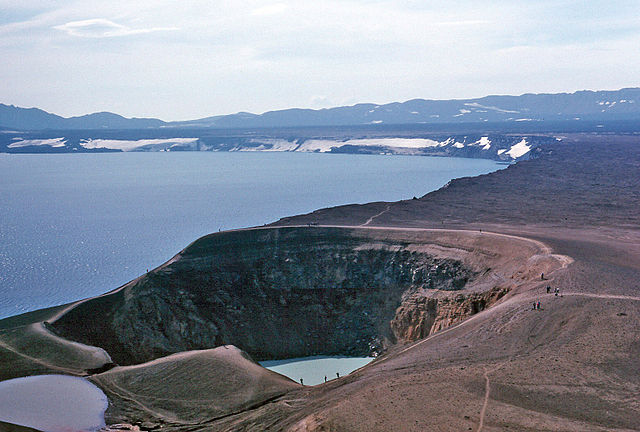
Lagniappe for Askja post


Leonardo Antonio Avezzano/Shutterstock


Today’s Askja post.

Its lagniappe in full:

Briefly, on Friday somebody quickly responded when I forwarded a tweet of theirs, about the latest science update on Askja, adding the comment that Viti’s crater lake is open. (My updates on unrest news are here.)

Their response was simply that Lake Viti has a high sulfur content and is usually in the low 20s C — roughly 68° to 75° F.

😎

That definitely explains it — the place would be a hydrothermal tourist attraction if it contained less sulfur, so people could swim in it, and wasn’t waaaaaay out in the subarctic winter boonies!

That was all; the rest of this describes a quite separate chain of thought it triggered based on other things I’ve noticed recently, including but not limited to:

  • Over twenty-some years, scientists appear to have shifted from “damage control” mode when publicly discussing dangerous volcanoes — as in, for example, ‘NO! Yellowstone isn’t going to blow!’ — to engagement, as in, ‘Well, someday Yellowstone probably will have another supereruption but not any time soon, and in the meantime, look at all this neat stuff!’

    It’s almost as though the boffins have been reading and writing articles like this!

  • A large segment of the public is only interested in sensationalism, but they’re losing ground to the rest of us, who are quite willing to be entertained by tales of UFOs hovering above Popocatépetl, etc., but who also take serious threats like dangerous volcanoes seriously; as we are learning more facts and starting to glimpse the big picture (“look at all this neat stuff!”), we want more detailed information.

    And if you’ve followed recent public outreach work by volcanologists — for example, at Taupo supervolcano, Mauna Loa and Mount Merapi Decade Volcanoes, and of course, the evergreen Yellowstone Caldera Chronicles and Volcano Watch — you know we are getting that info. 😍

  • Why are only a few scientists, like Dr. Thordarson and those quoted here, talking to the media about Askja? I have no idea, of course, but that put me into a ‘what if?’ mood.

I remember a few sensational rumors about Askja’s potential violence back in 2014, before and during the Bardarbunga/Holuhraun eruption. I don’t recall any official mention of possible explosiveness before or during that gorgeous effusive event.

That the possibility was taken seriously at the time has been mentioned in later research papers, including the one quoted in the Askja post.

Today’s public Askja hysteria is so strong on YouTube that I can hardly find decent videos. Again, most officials aren’t commenting on this round of volcanic unrest at Askja, though a few knowledgeable individuals are.

What if those officials, rightly or not, don’t trust us with the thought that an explosive eruption might be one — just one — of the scenarios if — a big if — unrest at Askja escalates into an eruption, as it did quite peacefully in 1961?

Don’t we all lose something by that?

And yes, there’s the possible economic effects to consider if Askja explosions ever happened, disrupting international air traffic, but let’s face it: some Icelandic volcano is going to do that, as Eyjafjallajokull did in 2010.

If not Askja, then Grimsvotn, Katla, or any one (or more) of a number of other volcanoes.

So what? It hasn’t been a hundred years yet since Lindbergh first made it to Paris — there’s still plenty of room outside the box to think up solutions before the problem hits us.

If we dare, as Lindbergh did.

I’m raising questions here that have no good answers only to explain why the tweet sequence about Lake Viti Friday, catching me in a thoughtful mood, also helped me decide what to do about an excellent but terrifying video I had come across while searching for this week’s Friday-cat-post guest video.


Segue/bridge: Explosive eruptions like Askja 1875 are awful, doubly so in this air-travel age, AND huge spiders are terrifying.


Askja Volcano seems to be a good center for of all sorts of “-sophy” and “-ology”: philosophy (jargon alert); geology (above linked Askja post); and, I think, biology (below).

[SPOILERS, or is it CAVEAT?]

No, the volcano isn’t mentioned in this video, which has over a million views —


https://youtu.be/Xm8XAaA40bM&rel=0


— but something scary is: the bit about that bird-eating spider.

I can imagine the director and other decision-makers planning that one out:


B, C & D: GAH!

A: People will watch it — we’ve shown other grisly examples of predation here.

B: But it’s a bird-eating spider! I’ve had to call my therapist TWICE since watching it go after Tweetie!

A: Well, nobody knew the cage was open; the canary got out —

C: I don’t think we should present arachnids as creepy — they’re just animals. I forced myself to watch a tarantula in a New Mexico parking lot once and realized it’s just another natural –

A & B: Shut up! Everybody wants ‘creepy’ with spiders. Anything else would feel fake.

C: But it’s real! People shouldn’t be scared of the real thing, just careful.

D: How ’bout a mouse? They’re used to video scenes of cats preying on rodents, right?

A: Well…we could stage something, maybe with a nest of mice babies and the big spider approaching…

THING UNDER TABLE: Cool!

A, B, C, & D: Faked!

A: Somebody go put that Thing out in the sun for a while.

C: I want the ending to be a little girl safely laughing at a nasty-looking spider!


Doubtlessly, the actual making of this video was quite different, but that spider section is hard to take, even though you can see that the spider is nowhere near the actual nest, separated from it probably by several glass plates.

Nevertheless, we all feel the mouse parent’s fear and horror — which is the reality of nature that no one otherwise can film.

There are so many other good things in this video — the cheetah segment, for instance, showing the cat’s muscle power as well as its speed, like a linebacker gracefully clearing hurdles during a track event.

The spider ruined this as a feel-good Friday video, but I kept watching. They eventually got to humans and I was ready for the trite “we’re destroying everything” message. It never came.

It’s an excellent ending, and that last scene totally justifies the spider section, though I cannot express why in words, any more than this philospher, quoted by Pall Skulason (jargon alert), could describe Askja’s effect on him:

At my first glimpse, I had to look away. Nothing like that has happened to me before or since, to be struck dumb by landscape. But there is some magic attached to Askja, some awesome, disturbing force that took me unawares and that I could not at first withstand, there in my solitude. I have never seen anything as astonishing or powerful. It was as if the magnificent view which I had enjoyed just a moment before had been erased from my mind, and with the terror of animate flesh, I was confronted by this awesome wonder of inanimate nature. There is no hope of describing Askja in any meaningful way. Who can describe a great work of art? Words and images are like the mere clanging of metal or the beating of a bell. And the same applies to any attempt to describe Askja.


As G. K. Chesterton put it, in A Defence of Heraldry, “There is a road from the eye to the heart that does not go through the intellect.”

It’s too bad that people try to sell us stuff through that road — the same medium as the one our intellects use for news and entertainment.

Additionally, it’s hard to engage our intellects when there is an active volcano stirring our eyes and heart.

That is a human thing, applying to scientists and laypeople alike.

Then we all have to function, and everyone moves out across the spectrum — volcanologists heading toward the “intellect” extreme, some YouTubers & Co. romping off to the “sensation” end — but, hopefully, with most of us clustering somewhere near the middle.

That works out best for everybody in the end.

As for the imaginary dialog above:

  • Some folks on YouTube and elsewhere online and in other forms of media are like A and B, above. They know what grabs attention and cater only to that.
  • I’m C — yes, I forced myself to look closely at one of the brown tarantulas crawling across a Tucumcari parking lot one day in 1987 and saw it, for the first time, as a fellow animal and a wonder. (This did not send me to the extreme of keeping one as a pet, but it cured me of any tendency toward the other extreme: unthinking arachnocide.)
  • D? Well, it just seemed to fit; you know, somebody who can communicate with the intended audience and who knows that it’s necessary to somehow work this messy thing into a picture they can show to others. It could be a scientist, as D is using their intellect, eye, AND heart.

    Or it could be a philospher like Skulason:

    The task ahead is to elaborate the concept of wholeness in order to make us capable of overcoming the ideology of efficiency and prepare for a much healthier world, where we humans learn to make peace with the powers of Nature – in our minds and in our actions. And for this task, we all have to find our own Askja.


A Personal Note: Stalking


August 24, 2022: This is not something that I want to mix up very much with my professional life, but it is probably a good idea to get a few things out in front of the world, as I have been (and continue to be) stalked by people I believe to be birth family and possibly also my adopted brother David since the late 90s when my adoptive (and also biological) father Ed Beier died, in McCalla, Alabama.

I don’t know if this considered incorrect speech in 21st-century America, but the truth is that he was a mean, snobbish, psychologically wounded and psychologically cruel German-American and I suspect that during the 1950s, in New England, he had somehow gotten involved with a really messed up Irish-American family who was not without its own cruel twists, as well as influence and money.

I was the result. Somehow Ed got custody of me at age three, and I think the birth family was so obsessive about me that everyone tried to use me as leverage on them.

I don’t know and it really won’t matter until I can get some investigators to look into it. The practical result was that no one told me anything about my background, and I grew up sort of as a Marilyn among the Munsters (cultural reference from those times).

This was aided by my own burial of memories of some traumatic events in childhood.

In the late 1970s, I got the heck out of that awful Beier family, screwed up big time out in the world on my own, but was helped and encouraged by the first authority figures I’d ever encountered who sincerely cared about me, and my life took a new and positive path that has borne much fruit ever since.

This is not a biography, but that setup is necessary for me to make the following points in public:

  1. I never went back to that Beier family after leaving it (actually, it broke up in a messy divorce; I orbited Ed at a distance but had nothing more to do with Marge and briefly made contact with David in the early 90s but locked him out for abuse of something I had trusted him with and have had nothing more to do with him since).
  2. I don’t know anything definite about the birth family except for what I’ve been able to infer from birth certificates. (Massachusetts lets you see your preadoption certificate.)
  3. My personal life has basically been hell since Ed died in the late 90s; I think these stalkers are the birth family and possibly also David, but they’re very good at stalking and I can prove nothing yet.
  4. I am socially isolated at the moment, as well as living on Social Security, but with the help of my New England backbone of granite, innate optimism, and solid practice of Theravada Buddhism, I’m okay and know that, despite those diehard Munsters, this Marilyn will eventually take her place in the wonderful state of Oregon as a happy, socially busy citizen and as a successful professional writer.
  5. I do need your help though. I think the stalkers are trying to avoid responsibility for their criminal actions — and hoping to solidify their control so they can dish out more abuse in the future — by making this out to be a “family affair.”

    It is not, and yet I have found a peculiar unwillingness in others to believe what I say when I have looked to outside sources for help. That is a classic stalker move, and it is very difficult to counter.

    It’s asking a lot, but if anyone has communicated with you in any way about me, saying things that don’t jive with what is mentioned above, please document it in a way that will convince an investigator to take my case — I’ve been to the police a few times and got nowhere — and contact me about it at bblegaloffensive2017@gmail.com dnevins360@gmail.com.

    I don’t care how true whatever they might be saying sounds. Test it yourself; or imagine me there, saying to these people, as I will say to them, if I can ever get them on the witness stand under oath: ” Who are you? What is your basis for intruding into my life?”

    People who really care about you are delighted to introduce themselves to you. People who have valid reasons to meet you aren’t afraid to show them and, if challenged, prove them.

    Just to sum up everything I’ve experienced from these stalkers over the last 2-1/2 decades, these people are not those people.

    And I want to get their names, expose their slander and other crimes, and put an end to this once and for all.

    This is not easy to do when faced with such hatred in such a cult family.

    They haven’t had custody of me since 1956, and I have healthcare affidavits on file in the 2020s that, while necessarily vague, hopefully will prevent them from regaining that custody if I get ill.

    But I’d much rather skip all this aggravation and grief, continue writing about wonderful things, enjoy my gray years as much as possible, and maybe, just maybe see a volcano erupt (a little).

    Thank you in advance for helping me get this stalking stopped, if you ever find yourself in a position to do that.

    I won’t respond to questions, business offers, or anything like that, but if you email me with anything solid, I’ll get back to you as soon as possible.

Update, August 25, 2022: I couldn’t get into the legaloffensive account; please use dnevins360@gmail.com. To confirm it’s really me, that’s the account I use for YouTube videos on Hunga Tonga optical effects.

Precambrian Source List


Arndt, N. T., and Nisbet, E. G. 2012. Processes on the young Earth and the habitats of early life. Annual Review of Earth and Planetary Sciences, 40: 521-549.

Aubert et al. 2015. Long-term Evolution…Magnetic Field

Bekker and Holland 2012 Oxygen overshoot (Abstract only)

Beraldi-Campesi, H. 2013. Early life on land and the first terrestrial ecosystems. Ecological Processes, 2(1): 1-17.

Bernstein, H.; Byers, G. S.; and Michod, R. E. 1981. Evolution of sexual reproduction: importance of DNA repair, complementation, and variation. The American Naturalist, 117(4): 537-549.

Black, B. A.; Karlstrom, L.; and Mather, T. A. 2021. The life cycle of large igneous provinces. Nature Reviews Earth & Environment, 2(12): 840-857.

Black, B.; Mittal, T.; Lingo, F.; Walowski, K.; and Hernandez, A. 2021a. Assessing the environmental consequences of the generation and alteration of mafic volcaniclastic deposits during large igneous province emplacement. Large Igneous Provinces: A Driver of Global Environmental and Biotic Changes, 117-131. https://agupubs.onlinelibrary.wiley.com/doi/10.1002/9781119507444.ch5

Bleeker, W. 2003. The late Archean record: a puzzle in ca. 35 pieces. Lithos, 71(2-4): 99-134.

Bond, D. P., and Sun, Y. 2021. Global Warming and Mass Extinctions Associated With Large Igneous Province Volcanism. Large Igneous Provinces: A Driver of Global Environmental and Biotic Changes, 83-102. https://agupubs.onlinelibrary.wiley.com/doi/10.1002/9781119507444.ch3

Bowman, J. C.; Petrov, A. S.; Frenkel-Pinter, M.; Penev, P. I.; and Williams, L. D. 2020. Root of the tree: the significance, evolution, and origins of the ribosome. (Abstract only.) Chemical Reviews, 120(11): 4848-4878.

Bowyer, F.; Wood, R. A.; and Poulton, S. W. 2017. Controls on the evolution of Ediacaran metazoan ecosystems: a redox perspective. Geobiology, 15(4): 516-551.

Bradley, D. C. 2011. Secular trends in the geologic record and the supercontinent cycle. Earth-Science Reviews, 108(1-2): 16-33.

Brown, J. H.; Gillooly, J. F.; Allen, A. P.; Savage, V. M.; and West, G. B. 2004. Toward a metabolic theory of ecology. Ecology, 85(7): 1771-1789.

Bryan, S. E., and Ernst, R. E. 2008. Revised definition of large igneous provinces (LIPs). Earth-Science Reviews, 86(1-4): 175-202.

Burford, E. P.; Fomina, M.; and Gadd, G. M. 2003. Fungal involvement in bioweathering and biotransformation of rocks and minerals. Mineralogical Magazine, 67(6): 1127-1155.

Butterfield, N. J. 2000. Bangiomorpha pubescens n. gen., n. sp.: implications for the evolution of sex, multicellularity, and the Mesoproterozoic/Neoproterozoic radiation of eukaryotes. Paleobiology, 26(3): 386-404.

Campbell, I. H., and Allen, C. M. 2008. Formation of supercontinents linked to increases in atmospheric oxygen. Nature Geoscience, 1(8): 554-558.

Carlson, R. W.; Garçon, M.; O’neil, J.; Reimink, J.; and Rizo, H. 2019. The nature of Earth’s first crust. Chemical Geology, 530: 119321.

Catling, D. C., and Zahnle, K. J. 2020. The Archean atmosphere. Science Advances, 6(9): eaax1420. https://www.science.org/doi/10.1126/sciadv.aax1420

Condie, K. C., and O’Neill, C. 2010. The Archean-Proterozoic boundary: 500 My of tectonic transition in Earth history. American Journal of Science, 310(9): 775-790.

Corsetti, F. A.; Olcott, A. N.; and Bakermans, C. 2006. The biotic response to Neoproterozoic snowball Earth. Palaeogeography, Palaeoclimatology, Palaeoecology, 232(2-4): 114-130.

Dang, Z., Zhang, N., Li, Z. X., Huang, C., Spencer, C. J., & Liu, Y. (2020). Weak orogenic lithosphere guides the pattern of plume-triggered supercontinent break-up. Communications Earth & Environment, 1(1), 1-11.
https://www.nature.com/articles/s43247-020-00052-z

David, V. A.; Menotti-Raymond, M.; Wallace, A. C.; Roelke, M.; and others. 2014. Endogenous retrovirus insertion in the KIT oncogene determines white and white spotting in domestic cats. G3: Genes, Genomes, Genetics, g3-114.

Diamond, C. W.; Ernst, R. E.; Zhang, S. H.; and Lyons, T. W. 2021. Breaking the Boring Billion: A Case for Solid‐Earth Processes as Drivers of System‐Scale Environmental Variability During the Mid‐Proterozoic. Large Igneous Provinces: A Driver of Global Environmental and Biotic Changes, 487-501.

Doolittle, W. F., and Brown, J. R. 1994. Tempo, mode, the progenote, and the universal root. Proceedings of the National Academy of Sciences, 91(15), 6721-6728.

Droser, M. L., and Gehling, J. G. 2015. The advent of animals: the view from the Ediacaran. Proceedings of the National Academy of Sciences, 112(16): 4865-4870.

Dunn, F. S.; Liu, A. G.; and Donoghue, P. C. 2018. Ediacaran developmental biology. Biological Reviews, 93(2): 914-932.

Durzyńska, J., and Goździcka-Józefiak, A. (2015). Viruses and cells intertwined since the dawn of evolution. Virology journal, 12(1), 1-10.

El Albani, A.; Bengtson, S.; Canfield, D. E.; Riboulleau, A.; and others. 2014. The 2.1 Ga old Francevillian biota: biogenicity, taphonomy and biodiversity. PLoS One, 9(6): e99438.

Endres, R. G. 2017. Entropy production selects nonequilibrium states in multistable systems. Scientific Reports, 7(1): 1-13.

Ernst, R. E., and Youbi, N. 2017. How Large Igneous Provinces affect global climate, sometimes cause mass extinctions, and represent natural markers in the geological record. Palaeogeography, Palaeoclimatology, Palaeoecology, 478: 30-52.

Ernst, R. E.; Wingate, M. T. D.; Buchan, K. L.; and Li, Z. X. 2008. Global record of 1600–700 Ma Large Igneous Provinces (LIPs): implications for the reconstruction of the proposed Nuna (Columbia) and Rodinia supercontinents. Precambrian Research, 160(1-2): 159-178.

Ernst, R. E.; Bleeker, W.; Söderlund, U.; and Kerr, A. C. 2013. Large igneous provinces and supercontinents: Toward completing the plate tectonic revolution. Lithos, 174: 1-14.

Ernst, R. E.; Bond, D. P.; Zhang, S. H.; Buchan, K. L.; and others. 2021. Large Igneous Province Record Through Time and Implications for Secular Environmental Changes and Geological Time‐Scale Boundaries. Large Igneous Provinces: A Driver of Global Environmental and Biotic Changes, 1-26.

Ernst, W. G. 2009. Archean plate tectonics, rise of Proterozoic supercontinentality and onset of regional, episodic stagnant-lid behavior. Gondwana Research, 15(3-4): 243-253.

Evans, D. A., and Mitchell, R. N. 2011. Assembly and breakup of the core of Paleoproterozoic–Mesoproterozoic supercontinent Nuna. Geology, 39(5): 443-446.

Fedonkin, M. A. 2003. The origin of the Metazoa in the light of the Proterozoic fossil record. Paleontological Research, 7(1): 9-41.

Finke, N.; Simister, R. L.; O’Neil, A. H.; Nomosatryo, S.; and others. 2019. Mesophilic microorganisms build terrestrial mats analogous to Precambrian microbial jungles. Nature Communications, 10(1): 1-11.

Fiorentini, M. L.; O’Neill, C.; Giuliani, A.; Choi, E.; and others. 2020. Bushveld superplume drove Proterozoic magmatism and metallogenesis in Australia. Scientific Reports, 10(1): 1-10.

Foley, B. J., and Driscoll, P. E. 2016. Whole planet coupling between climate, mantle, and core: Implications for rocky planet evolution. Geochemistry, Geophysics, Geosystems, 17(5): 1885-1914.

Fox, G. E. 2010. Origin and evolution of the ribosome. Cold Spring Harbor Perspectives in Biology, 2(9), a003483.

Gan, Z.; Yan, Y.; and Qi, Y. 2004. Entropy budget of the earth, atmosphere and ocean system. Progress in Natural Science, 14(12): 1088-1094.

Genikhovich, G., and Technau, U. 2017. On the evolution of bilaterality. Development, 144(19): 3392-3404.

Goldblatt, C.; Lenton, T. M.; and Watson, A. J. 2006. Bistability of atmospheric oxygen and the Great Oxidation. Nature, 443(7112): 683-686.

Gradstein, F. M.; Ogg, J. G.; and Hilgen, F. G. 2012. On the geologic time scale. Newsletters on Stratigraphy. 45(2):171-188.

Grieve, R., and Therriault, A. 2000. Vredefort, Sudbury, Chicxulub: three of a kind?. Annual Review of Earth and Planetary Sciences, 28(1): 305-338.

Gutteridge, J. M., and Halliwell, B. 2018. Mini-review: oxidative stress, redox stress or redox success?. Biochemical and biophysical research communications, 502(2): 183-186.

Hazen, R. M.; Papineau, D.; Bleeker, W.; Downs, R. T.; and others. 2008. Mineral evolution. American Mineralogist, 93(11-12): 1693-1720.

Hoffman, P. F.; Abbot, D. S.; Ashkenazy, Y.; Benn, D. I.; and others. 2017. Snowball Earth climate dynamics and Cryogenian geology-geobiology. Science Advances, 3(11): e1600983.

Hohmann-Marriott, M. F., and Blankenship, R. E. 2011. Evolution of photosynthesis. Annual Review of Plant Biology, 62: 515-548.

Hou, X., and Bergström, J. 2003. The Chengjiang fauna—the oldest preserved animal community. Paleontological Research, 7(1): 55-70.

Hsia, C. C.; Schmitz, A.; Lambertz, M.; Perry, S. F.; and Maina, J. N. 2013. Evolution of air breathing: oxygen homeostasis and the transitions from water to land and sky. Comprehensive Physiology, 3(2): 849.

Huston, D. L.; Pehrsson, S.; Eglington, B. M.; and Zaw, K. 2010. The geology and metallogeny of volcanic-hosted massive sulfide deposits: Variations through geologic time and with tectonic setting. Economic Geology, 105(3): 571-591.

Jahren, A. H. 2002. The biogeochemical consequences of the mid-Cretaceous superplume. Journal of Geodynamics, 34(2): 177-191.

Javaux, E. J., and Lepot, K. 2018. The Paleoproterozoic fossil record: implications for the evolution of the biosphere during Earth’s middle-age. Earth-Science Reviews, 176: 68-86.

Johansson, Å.; Bingen, B.; Huhma, H.; Waight, T.; and others. 2022. A geochronological review of magmatism along the external margin of Columbia and in the Grenville-age orogens forming the core of Rodinia. Precambrian Research, 371: 106463.

Kasting, J. F. 2019. The Goldilocks planet? How silicate weathering maintains Earth “just right”. Elements: An International Magazine of Mineralogy, Geochemistry, and Petrology, 15(4): 235-240.

Keller, C. B.; Husson, J. M.; Mitchell, R. N.; Bottke, W. F.; and others. 2019. Neoproterozoic glacial origin of the Great Unconformity. Proceedings of the National Academy of Sciences, 116(4): 1136-1145.

Keller, G. 2005. Impacts, volcanism and mass extinction: random coincidence or cause and effect?. Australian Journal of Earth Sciences, 52(4-5): 725-757.

Keller, G. 2008. Cretaceous climate, volcanism, impacts, and biotic effects. Cretaceous Research, 29(5-6): 754-771.

Kenrick, P., and Crane, P. R. 1997. The origin and early evolution of plants on land. Nature, 389(6646): 33-39.

Kharecha, P.; Kasting, J.; and Siefert, J. 2005. A coupled atmosphere–ecosystem model of the early Archean Earth. Geobiology, 3(2): 53-76.

Kitadai, N., and Maruyama, S. 2018. Origins of building blocks of life: A review. Geoscience Frontiers, 9(4): 1117-1153.

Klatt, J. M.; Chennu, A.; Arbic, B. K.; Biddanda, B. A.; and Dick, G. J. 2021. Possible link between Earth’s rotation rate and oxygenation. Nature Geoscience, 14(8): 564-570.

Kleidon, A. 2010. A basic introduction to the thermodynamics of the Earth system far from equilibrium and maximum entropy production. Philosophical Transactions of the Royal Society B: Biological Sciences, 365(1545): 1303-1315. https://www.ncbi.nlm.nih.gov/pmc/articles/PMC2871909/

Knoll, A. H. 2003. Biomineralization and evolutionary history. Reviews in Mineralogy and Geochemistry, 54(1): 329-356.

___. 2014. Paleobiological perspectives on early eukaryotic evolution. Cold Spring Harbor Perspectives in Biology, 6(1): a016121.

Koonin, E. V. 2010. The origin and early evolution of eukaryotes in the light of phylogenomics. Genome Biology, 11(5): 1-12.

Kopp, R. E.; Kirschvink, J. L.; Hilburn, I. A.; and Nash, C. Z. 2005. The Paleoproterozoic snowball Earth: a climate disaster triggered by the evolution of oxygenic photosynthesis. Proceedings of the National Academy of Sciences, 102(32): 11131-11136.

Korenaga, J. 2006. Archean geodynamics and the thermal evolution of Earth. Geophysical Monograph-American Geophysical Union, 164: 7.

Korenaga, J.; Planavsky, N. J.; and Evans, D. A. 2017. Global water cycle and the coevolution of the Earth’s interior and surface environment. Philosophical Transactions of the Royal Society A: Mathematical, Physical and Engineering Sciences, 375(2094): 20150393.

Krupovic, M.; Dolja, V. V., and Koonin, E. V. 2020. The LUCA and its complex virome. Nature Reviews Microbiology, 18(11): 661-670.

Lemons, D., and McGinnis, W. 2006. Genomic evolution of Hox gene clusters. Science, 313(5795): 1918-1922.

Li, Z. X.; Evans, D. A.; and Halverson, G. P. 2013. Neoproterozoic glaciations in a revised global palaeogeography from the breakup of Rodinia to the assembly of Gondwanaland. Sedimentary Geology, 294: 219-232.

Lindsay, J. F., and Brasier, M. D. 2002. Did global tectonics drive early biosphere evolution? Carbon isotope record from 2.6 to 1.9 Ga carbonates of Western Australian basins. Precambrian Research, 114(1-2): 1-34.

Liu, J.; Xia, Q. K.; Kuritani, T.; Hanski, E.; and Yu, H. R. 2017. Mantle hydration and the role of water in the generation of large igneous provinces. Nature Communications, 8(1): 1-8.

Lubnina, N. V., and Slabunov, A. I. 2011. Reconstruction of the Kenorland supercontinent in the Neoarchean based on paleomagnetic and geological data. Moscow University Geology Bulletin, 66(4): 242-249.

Maizels, N., and Weiner, A. M. 1994. Phylogeny from function: evidence from the molecular fossil record that tRNA originated in replication, not translation. Proceedings of the National Academy of Sciences, 91(15), 6729-6734.

Maruyama, S.; Santosh, M.; and Zhao, D. 2007. Superplume, supercontinent, and post-perovskite: mantle dynamics and anti-plate tectonics on the core–mantle boundary. Gondwana Research, 11(1-2): 7-37.

Maruyama, S.; Ikoma, M.; Genda, H.; Hirose, K.; and others. 2013. The naked planet Earth: most essential pre-requisite for the origin and evolution of life. Geoscience Frontiers, 4(2): 141-165.

Mather, T. A., and Schmidt, A. 2021. Environmental effects of volcanic volatile fluxes from subaerial large igneous provinces. Large Igneous Provinces: A Driver of Global Environmental and Biotic Changes, 103-116. https://agupubs.onlinelibrary.wiley.com/doi/10.1002/9781119507444.ch4

Mazumder, R., and Arima, M. 2005. Tidal rhythmites and their implications. Earth-Science Reviews, 69(1-2): 79-95.

McNamara, A. K. 2019. A review of large low shear velocity provinces and ultra low velocity zones. Tectonophysics, 760: 199-220.

Meert, J. G. 2012. What’s in a name? The Columbia (Paleopangaea/Nuna) supercontinent. Gondwana Research, 21(4), 987-993.

Meert, J. G., and Santosh, M. 2017. The Columbia supercontinent revisited. Gondwana Research, 50: 67-83.

Moczydłowska, M. 2008. The Ediacaran microbiota and the survival of Snowball Earth conditions. Precambrian Research, 167(1-2): 1-15.

Morton, M. C. 2017. When and how did plate tectonics begin on Earth? https://www.earthmagazine.org/article/when-and-how-did-plate-tectonics-begin-earth/

Mukherjee, I.; Large, R. R.; Corkrey, R.; and Danyushevsky, L. V. 2018. The Boring Billion, a slingshot for complex life on Earth. Scientific Reports, 8(1): 1-7.

Mulkidjanian, A. Y.; Bychkov, A. Y.; Dibrova, D. V.; Galperin, M. Y.; and Koonin, E. V. 2012. Origin of first cells at terrestrial, anoxic geothermal fields. Proceedings of the National Academy of Sciences, 109(14): E821-E830. https://www.pnas.org/content/109/14/E821.long

Nance, R. D.; Worsley, T. R.; and Moody, J. B. 1986. Post-Archean biogeochemical cycles and long-term episodicity in tectonic processes. Geology, 14(6): 514-518.

Nance, R. D.; Murphy, J. B.; and Santosh, M. 2014. The supercontinent cycle: a retrospective essay. Gondwana Research, 25(1): 4-29.

Narbonne, G. M. (2005). The Ediacara biota: Neoproterozoic origin of animals and their ecosystems. Annu. Rev. Earth Planet. Sci., 33, 421-442.

NASA. 2020a. Can we find life? https://exoplanets.nasa.gov/search-for-life/can-we-find-life/ Last accessed July 12, 2021.

___. 2020b. Life in our Solar System? Meet the neighbors. https://exoplanets.nasa.gov/news/1665/life-in-our-solar-system-meet-the-neighbors/ Last accessed July 12, 2021.

___. 2021. NASA selects 2 missions to study “lost habitable” world of Venus. https://www.nasa.gov/press-release/nasa-selects-2-missions-to-study-lost-habitable-world-of-venus Last accessed July 12, 2021.

___. 2021a. Then there were 3: NASA to collaborate on ESA’s new Venus mission. https://www.nasa.gov/feature/then-there-were-3-nasa-to-collaborate-on-esa-s-new-venus-mission Last accessed July 12, 2021.

___. 2021b. Venus overview. https://solarsystem.nasa.gov/planets/venus/overview/ Last accessed July 12, 2021.

___. 2021c. The searchers: How will NASA look for signs of life beyond Earth? https://exoplanets.nasa.gov/news/1681/the-searchers-how-will-nasa-look-for-signs-of-life-beyond-earth/ Last accessed July 12, 2021.

__. 2021d. Life in the universe: What are the odds? https://exoplanets.nasa.gov/news/1675/life-in-the-universe-what-are-the-odds/ Last accessed July 12, 2021.

___. 2021f. What’s out there? The exoplanet sky so far? https://exoplanets.nasa.gov/news/1673/whats-out-there-the-exoplanet-sky-so-far/ Last accessed July 12, 2021.

___. 2021e. Mars 2020 Perseverance rover. https://mars.nasa.gov/mars-exploration/missions/mars2020/ Last accessed July 12, 2021.

___. n.d. Europa Clipper: Ingredients for life. https://europa.nasa.gov/why-europa/ingr.edients-for-life/ Last accessed July 12, 2021

O’Donnell, M., Langston, L., and Stillman, B. 2013. Principles and concepts of DNA replication in bacteria, archaea, and eukarya. Cold Spring Harbor perspectives in biology, 5(7), a010108.

Oppenheimer, C. 2011. Eruptions That Shook the World. Cambridge: Cambridge University Press. Retrieved from https://play.google.com/store/books/details?id=qW1UNwhuhnUC

Palin, R. M., and Santosh, M. 2020. Plate tectonics: What, where, why, and when?. Gondwana Research.

Park, Y.; Swanson‐Hysell, N. L.; Lisiecki, L. E.; and Macdonald, F. A. 2021. Evaluating the relationship between the area and latitude of large igneous provinces and Earth’s long‐term climate state. Large igneous provinces: A driver of global environmental and biotic changes, 153-168.

Pastor-Galán, D.; Nance, R. D.; Murphy, J. B.; and Spencer, C. J. 2019. Supercontinents: myths, mysteries, and milestones. Geological Society, London, Special Publications, 470(1): 39-64

Pehrsson, S. J.; Eglington, B. M.; Evans, D. A.; Huston, D.; and Reddy, S. M. 2016. Metallogeny and its link to orogenic style during the Nuna supercontinent cycle. Geological Society, London, Special Publications, 424(1): 83-94.

Peters, S. E., and Gaines, R. R. 2012. Formation of the ‘Great Unconformity’as a trigger for the Cambrian explosion. Nature, 484(7394): 363-366.

Peterson, K. J.; Lyons, J. B.; Nowak, K. S.; Takacs, C. M.; and others. 2004. Estimating metazoan divergence times with a molecular clock. Proceedings of the National Academy of Sciences, 101(17): 6536-6541.

Piombino, A. 2016. The heavy links between geological events and vascular plants evolution: a brief outline. International Journal of Evolutionary Biology, 2016.

Prokoph, A.; Ernst, R. E.; and Buchan, K. L. 2004. Time-series analysis of large igneous provinces: 3500 Ma to present. The Journal of Geology, 112(1): 1-22.

Prothero, D. R. 2006. After the Dinosaurs: The Age of Mammals. Bloomington and Indianapolis: Indiana University Press. Retrieved from https://play.google.com/store/books/details?id=Qh82IW-HHWAC

Racki, G. 2020. Volcanism as a prime cause of mass extinctions: Retrospectives and perspectives. In Mass Extinctions, Volcanism, and Impacts: New Developments (Vol. 544, pp. 1-34). Geological Society of America.

Reddy, S. M., and Evans, D. A. D. 2009. Palaeoproterozoic supercontinents and global evolution: correlations from core to atmosphere. Geological Society, London, Special Publications, 323(1), 1-26.

Roberts, N. M. (2013). The boring billion?–Lid tectonics, continental growth and environmental change associated with the Columbia supercontinent. Geoscience Frontiers, 4(6), 681-691.

Rogers, J. J., and Santosh, M. 2004. Continents and Supercontinents. Oxford University Press.

Rogers, J. J., and Santosh, M. 2009. Tectonics and surface effects of the supercontinent Columbia. Gondwana Research, 15(3-4): 373-380.

Root-Bernstein, M., and Root-Bernstein, R. 2015. The ribosome as a missing link in the evolution of life. Journal of Theoretical Biology, 367: 130-158.

Saladino, R.; Botta, G.; Pino, S.; Costanzo, G.; and Di Mauro, E. 2012. Genetics first or metabolism first? The formamide clue. Chemical Society Reviews, 41(16): 5526-5565.

Santosh, M. 2010. Supercontinent tectonics and biogeochemical cycle: a matter of ‘life and death’. Geoscience Frontiers, 1(1): 21-30.

Santosh, M. 2013. Evolution of continents, cratons and supercontinents: building the habitable Earth. Current Science, 871-879.

Santosh, M.; Maruyama, S.; and Yamamoto, S. 2009. The making and breaking of supercontinents: some speculations based on superplumes, super downwelling and the role of tectosphere. Gondwana Research, 15(3-4): 324-341.

Schopf, J. W. 1994. Disparate rates, differing fates: tempo and mode of evolution changed from the Precambrian to the Phanerozoic. Proceedings of the National Academy of Sciences, 91(15), 6735-6742.

Schwab, I. R. 2018. The evolution of eyes: Major steps. the Keeler lecture 2017: Centenary of Keeler Ltd. Eye, 32(2): 302-313.

Simpson, G. G. 1944. Tempo and Mode in Evolution. New York: Columbia University Press.

Sleep, N. H. 2010. The Hadean-Archaean environment. Cold Spring Harbor Perspectives in Biology, 2(6): a002527. http://m.cshperspectives.cshlp.org/content/2/6/a002527.long

Sleep, N. H., Bird, D. K., & Pope, E. C. 2011. Serpentinite and the dawn of life. Philosophical Transactions of the Royal Society B: Biological Sciences, 366(1580), 2857-2869. https://royalsocietypublishing.org/doi/full/10.1098/rstb.2011.0129

Spalding, C., and Fischer, W. W. 2019. A shorter Archean day-length biases interpretations of the early Earth’s climate. Earth and Planetary Science Letters, 514: 28-36.

Sperling, E. A.; Frieder, C. A.; Raman, A. V.; Girguis, P. R.; and others. 2013. Oxygen, ecology, and the Cambrian radiation of animals. Proceedings of the National Academy of Sciences, 110(33): 13446-13451.

Stern, R. J., and Miller, N. R. 2018. Did the transition to plate tectonics cause Neoproterozoic Snowball Earth?. Terra Nova, 30(2): 87-94.

Stern, R. J., and Miller, N. R. 2021. Neoproterozoic Glaciation—Snowball Earth Hypothesis. Encyclopedia of Geology, 546-556. https://www.researchgate.net/profile/Bob-Stern/publication/337557048_Neoproterozoic_Glaciation-Snowball_Earth_Hypothesis/links/5de2eefc4585159aa4578ecb/Neoproterozoic-Glaciation-Snowball-Earth-Hypothesis.pdf (PDF download)

Taylor, S. R., and McLennan, S. M. 1995. The geochemical evolution of the continental crust. Reviews of Geophysics, 33(2): 241-265.

Torsvik, T. H., and Cocks, L. R. M. 2013. Gondwana from top to base in space and time. Gondwana Research, 24(3-4): 999-1030.

Trewavas, A. 2003. Aspects of plant intelligence. Annals of botany, 92(1): 1-20.

Tsekhmistrenko, M.; Sigloch, K.; Hosseini, K.; and Barruol, G. 2021. A tree of Indo-African mantle plumes imaged by seismic tomography. Nature Geoscience, 14(8): 612-619.

UCAR n.d. How the Geosphere Rocks Climate. https://scied.ucar.edu/learning-zone/how-climate-works/how-geosphere-rocks-climate

Valentine, J. W., and Moores, E. M. 1970. Plate-tectonic regulation of faunal diversity and sea level: a model. Nature, 228(5272): 657-659.

van Maldegem, L. M.; Sansjofre, P.; Weijers, J. W.; Wolkenstein, K.; and others. 2019. Bisnorgammacerane traces predatory pressure and the persistent rise of algal ecosystems after Snowball Earth. Nature Communications, 10(1): 1-11.

Walker, S. I. 2017. Origins of life: a problem for physics, a key issues review. Reports on Progress in Physics, 80(9): 092601.

Walker, S. I.; Packard, N.; and Cody, G. D. 2017. Re-conceptualizing the origins of life. Philosophical Transactions of the Royal Society A: Mathematical, Physical and Engineering Sciences,375: 20160337.
https://royalsocietypublishing.org/doi/full/10.1098/rsta.2016.0337

Waltham, D. 2015. Milankovitch period uncertainties and their impact on cyclostratigraphy. Journal of Sedimentary Research, 85(8): 990-998.

Wang, C.; Mitchell, R. N.; Murphy, J. B.; Peng, P.; and Spencer, C. J. 2021. The role of megacontinents in the supercontinent cycle. Geology, 49(4): 402-406.

Weller, O. M., and St-Onge, M. R. 2017. Record of modern-style plate tectonics in the Palaeoproterozoic Trans-Hudson orogen. Nature Geoscience, 10(4): 305-311.

Wessner, D. R. 2010. The origins of viruses. Nature Education, 3(9), 37. https://www.nature.com/scitable/topicpage/the-origins-of-viruses-14398218/

Xiao, S., and Tang, Q. 2018. After the boring billion and before the freezing millions: evolutionary patterns and innovations in the Tonian Period. Emerging topics in life sciences, 2(2): 161-171.

Yale, L. B., and Carpenter, S. J. 1998. Large igneous provinces and giant dike swarms: proxies for supercontinent cyclicity and mantle convection. Earth and Planetary Science Letters, 163(1-4): 109-122.

Youbi, N.; Ernst, R. E.; Söderlund, U.; Boumehdi, M. A.; and others. 2020. The Central Iapetus magmatic province: An updated review and link with the ca. 580 Ma Gaskiers glaciation (Vol. 544, pp. 35-66). Geological Society of America Special Paper.

Youbi, N.; Ernst, R. E.; Mitchell, R. N.; Boumehdi, M. A.; and others. 2021. Preliminary Appraisal of a Correlation Between Glaciations and Large Igneous Provinces Over the Past 720 Million Years. Large Igneous Provinces: A Driver of Global Environmental and Biotic Changes, 169-190. https://agupubs.onlinelibrary.wiley.com/doi/10.1002/9781119507444.ch8

Young, G. M. 2013. Precambrian supercontinents, glaciations, atmospheric oxygenation, metazoan evolution and an impact that may have changed the second half of Earth history. Geoscience Frontiers, 4(3): 247-261.

Zahnle, K.; Schaefer, L.; and Fegley, B. 2010. Earth’s earliest atmospheres. Cold Spring Harbor Perspectives in Biology, 2(10): a004895. http://m.cshperspectives.cshlp.org/content/2/10/a004895.long

Zhang, X.; Shu, D.; Han, J.; Zhang, Z.; and others. 2014. Triggers for the Cambrian explosion: hypotheses and problems. Gondwana Research, 25(3): 896-909. (Abstract only)

Zhang, S. H.; Ernst, R. E.; Pei, J. L.; Zhao, Y.; and Hu, G. H. 2021. Large Igneous Provinces (LIPs) and Anoxia Events in “The Boring Billion”. Large Igneous Provinces: A Driver of Global Environmental and Biotic Changes, 449-486.

Zhao, G.; Sun, M.; Wilde, S. A.; and Li, S. 2004. A Paleo-Mesoproterozoic supercontinent: assembly, growth and breakup. Earth-Science Reviews, 67(1-2): 91-123.


Where Cats Come From: Draft


This definitely is a work in progress. Last summer, I blithely set up a simple outline of the book I am trying to write about how cats evolved. Then I started to do some research and, basically, got ambushed by the Precambrian.

I know that sounds weird, but a lot of stuff happened back then; it’s interesting enough to cover and still relevant today, but there are a lot of uncertainties about those ancient times.

I’m still working my way through it now.

I have been doing some posts meanwhile, originally intending them as chapters, but as I have learned more about the Precambrian, I also can see that these will all have to be redone at some point before resuming the expected flow of history with the tetrapods.

This page brings together those posts; while individually they’re interesting to readers, there is no overarching narrative yet. Only recently, with the supercontinents, did things really start to come together for me.

In the meantime, welcome to my work desk!

Update, May 10, 2022: Getting the Columbia/Nuna chapter together has really helped focus my thoughts. I can see now that everything before that must be rewritten/condensed into just a chapter or two, but I will wait until finishing the Gondwana to do that.


Picjumbo.com/Pixabay, public domain.


HOLD THE EUKARYOTES BRIEFLY (It’s okay; they actually did hang out, not doing much, for about a billion years before taking a dominant role)! GEOLOGY COMING THROUGH!

CUE THE EUKARYOTES!

  • Ediacaran Times.
  • The “Cambrian Explosion.”
  • The Age of Fish: Jaws and other neat features.
  • A “thriller” mass extinction.
  • Tetrapods.
  • Mammals vs. Dinosaurs: Round 1. ($)
  • Mammals vs. Dinosaurs, Round 2. ($)
  • Mammals vs. Dinosaurs, Round 3. ($)
  • The K/T (K/Pg) Extinction.($)
  • Paleocene Mammals and Dinosaurs. ($)
  • Carnivora.($)
  • Eocene Saber-toothed “Cats.” ($)
  • The Big Freeze.($)
  • Oligocene Wildlife.($)
  • Cats and “Dogs.” ($)
  • Miocene Saber-toothed “Cats.” ($)
  • Miocene Cats, With and Without Saberteeth. ($)
  • The Miocene-Pliocene Toll Bridge. ($)
  • Smilodon and Homotherium.($)
  • Main Character: Felinae, the “Cone-tooths.” ($)
  • South America is Invaded.($)
  • The Ice Ages Begin.($)
  • Seeking Refuge. ($)
  • Plio-Pleistocene Wildlife. ($)
  • Main Character: Us. ($)
  • The End of Sabertooths and Most Giants. ($)
  • Choosing Hard Work Over Life in Eden. ($)
  • Domestication of a Little Wildcat. ($)
  • Mercy.


Updated March 9, 2022.

Volcanism: A Main Character?


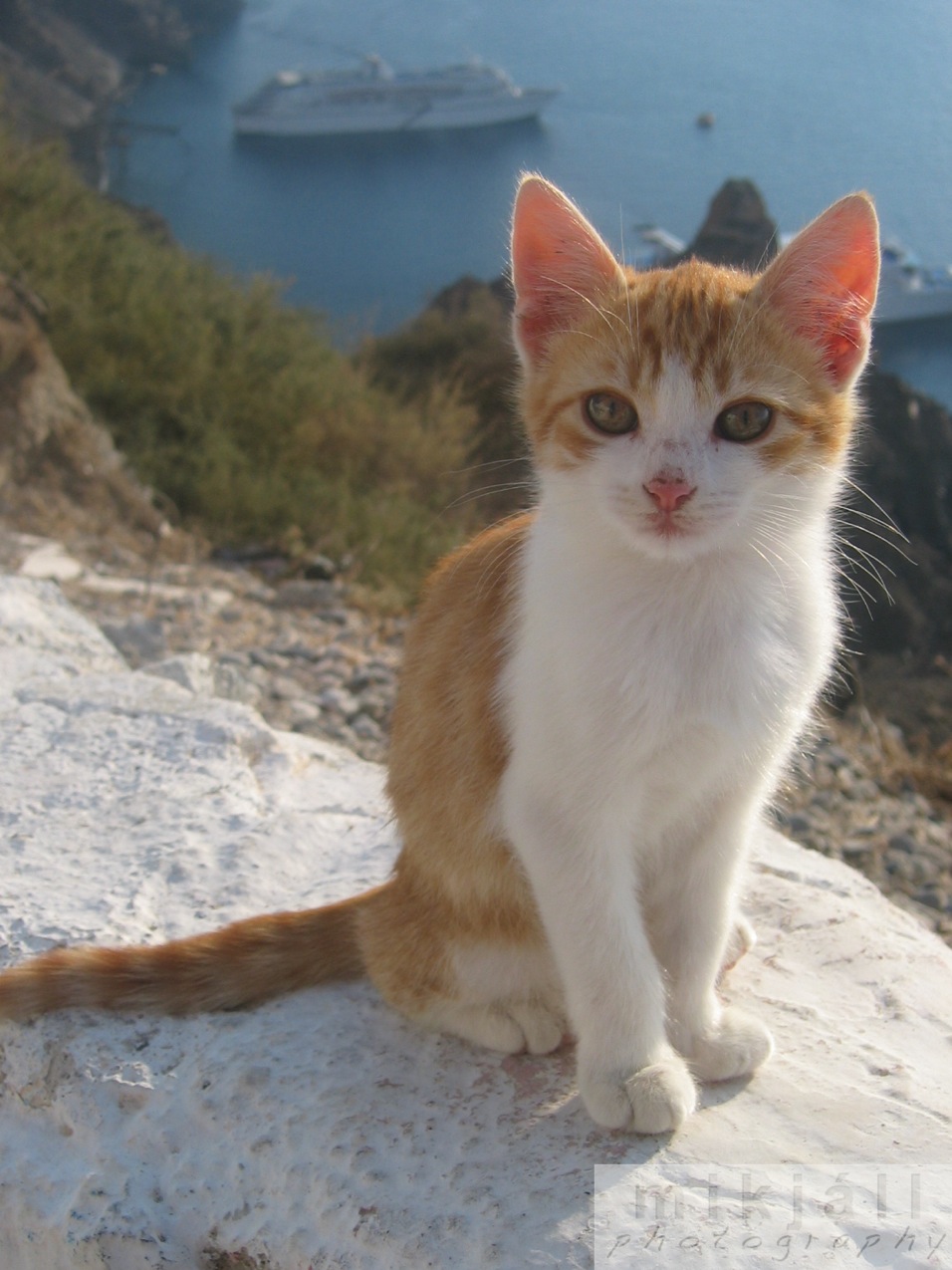
That’s the caldera of Santorini Volcano behind this beautiful little poser.

Now put on your hard hats — it’s time for a little chemistry.

Very little.

In fact, just this: “What do you get when you remove the oxygen (chemical symbol O) from H2O?”

Okay, so there’s really no need for special gear (unless you want to follow a working geologist out into the field to collect and study some of the world’s oldest rocks).

You get H2 — hydrogen — of course.

Believe it or not, this answer is closely tied to the origin of life on Earth. So is volcanism: source of the heat energy powering that and other chemical reactions necessary for emerging life.

Continue reading “Volcanism: A Main Character?”

Main Character: Plate Tectonics


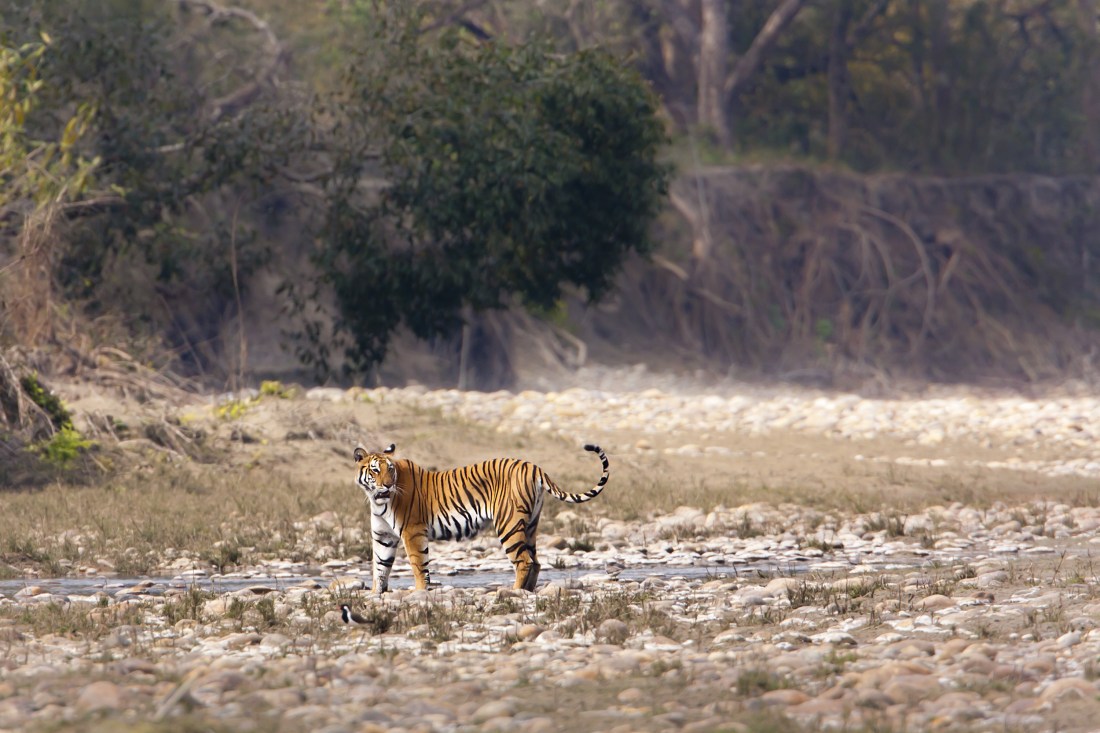
That tiger — and the little avian dinosaur in the foreground, keeping a respectful distance away from the cat — are walking along one of many river beds that cross the Terai, a flat grassy wetland that runs along the feet of the Himalayas in Bhutan, India, and Nepal.

This particular river is in Nepal, according to the photographer.

As you can see, Terai soil is deep and fertile, but mountain floods can slash through it easily. They also bring down the nearby towering range piece by piece as rounded boulders and cobblestones.

Thanks to plate tectonics, though, the Himalayas continue to rise despite this constant assault by rain and ice.

Down in the flatlands, a young Ganges River flows through the Terai, gathering in lesser streams like the one shown above and growing in size and volume as it travels more than a thousand miles eastward and then south to the distant Bay of Bengal.

India and Nepal established important nature preserves here in the early 1970s. Bengal tigers are also protected elsewhere in the region, including the Sunderbans: a vast mangrove forest that covers the Ganges Delta of India and Bangladesh.

What does all that have to do with plate tectonics?

Well, this:


https://youtu.be/A_K6LSSZ_34&rel=0


A few caveats to this excellent video: Per sources that I have read, other factors were also at work during the great greenhouse-icehouse transition, but let’s save that for Chapter 18. As I understand it, there is consensus on the evolution of whales, but otherwise the India-Asia collision and its effects on plant and animal life were very complex, as this abstract shows. Not all experts agree with Dr. Hughes. In a later chapter, though, we’ll look into another, even more controversial hypothesis: that big cats might have evolved in Tibet!


Cats and Plate Tectonics

Take the part in this video where they mention cooling, for instance.

Based on how cats behave now and the ways that behavior has shaped their anatomy and that of their fossil relatives down through time, it’s likely that Family Felidae evolved to fill a predator niche in an ecosystem that existed in between the forest’s edge and an open plain. (Martin).

That was ideal! There was sufficient cover to sneak up on prey (and trees to scoot up into when danger threatened), as well as just enough open space for a short sprint and deadly pounce. (Werdelin)


https://youtu.be/kK5Kq6tVMJg&rel=0


Now try to imagine a place like that in Late Cretaceous times.

Continue reading “Main Character: Plate Tectonics”

Main Character: Earth


Great news!

A spacecraft has found definite signs of life on a habitable world!

Well, it was Earth and the craft was a probe named Galileo that flew past its home in 1990 for an equipment check before sailing on to explore the Solar System as far as Jupiter. (Here’s how that turned out.)


https://youtu.be/UU-wmSEPiqw&rel=0


This isn’t from Galileo, but it is definitely cool. In 2020 NASA turned some of its data on Earth into music and released the video. Check out which instrument is “playing” atmosphere, water, etc., at the YouTube page.


Still, congratulations to the rocket scientists!

And even though our focus is on how cats evolved, we do need to look at Earth and ask the basic questions: where did it come from? What makes our planet such a good stage for, and cast member in, that ensemble play we call Life?

Only then will details in later chapters make sense, for instance, why cats have four legs and a long tail (mammal predators do have other options); the whole cat-dog thing and whether T. Rex ate any of their direct ancestors; why cats have pretty fur but scary claws and teeth (compared to our own flat fingernails and chompers), and so forth.

Continue reading “Main Character: Earth”